In Kenya Inspiration from Volunteers Connecting with Local People

Hello Kerubo! Could you briefly introduce yourself?

My name is Kerubo Nyaribo and I am the Programme Director for ICYE Kenya. I hold a Bachelor in Science in Botany and Zoology and a post graduate diploma in education and I have taken several short courses in different disciplines. I am a Christian, a wife to one man and a mother to three beautiful girls. I have been involved in ICYE in different capacities since 1986. Right now I am the director and I supervise the other staff in the office running the programmes and I am in charge of the European Voluntary Service. I work half time in the ICYE office and half time in my fashion design shop.

What attracted you to work for an international voluntary work organization?

I started ICYE Kenya with a few others and at the time we just wanted to make sure we could get young people from other countries to come to Kenya and send our youth to other countries. Thinking of what has kept me working for ICYE: Meeting these youth and training them has been very interesting for me, having been a teacher for many years. Also engaging with staff from other national committees of the ICYE network has been very enriching – especially the discussions we have and the different ways we view things because of our different cultural backgrounds.

Which have been the most inspiring aspects in your work lately?

This probably has not changed during the years, but seeing the volunteers connect with their host families and projects and seeing the changes that the volunteers’ presence can make in a community makes me want to continue to see it happening with different people in different ways!

ICYE Kenya participated in “the volunteer activist” project in which young citizen in 17 ICYE countries seeked to raise awareness through campaigns of the social concerns of our time. What motivated ICYE Kenya to take part in the project?

Volunteerism is not very highly rated in current Kenya, and we wanted to sensitize more people about what we do and have people appreciate our local and international volunteers. To have people stop and listen, see and get involved.

Could you tell a bit about the campaign actions you had in Kenya?

Our campaigning happened around a football tournament involving volunteers and youth in Sindo, one of our rural towns in Homabay County. As a campaing action there was also painting Msekwa Border Primary school classrooms. We will still have another activity on the 7th of December to commemorate the International Volunteer Day which is on the 5th of December.

Which of the “the volunteer activist” actions in other countries did you find the most interesting ones?

Activities in Nepal on waste management and in Vietnam on reducing plastic paper bags seemed the most interesting ones to me.

Which are the main sectors in which foreign long-term volunteers work in Kenya this season?

Most of them are working in primary schools and children’s homes

Your greetings for those Finnish young people thinking of volunteering in Kenya?

KARIBU KENYA! Welcome to Kenya! There are lots of places to volunteer, we are quite friendly as a people, and ICYE Kenya’s aim is to make sure you have the experience of your life! We care and appreciate our volunteers and look forward to hosting you.

The interview has been published in Volunteers’ Voices 4/2014 magazine.
 

Read also

MaailmanVaihtoa – Volunteers’ Voices 1/2023: Language and Communication

 In this issue Read the pdf version of the...

Greetings from abroad: From Finland to Austria and from Taiwan to Finland

Each year Maailmanvaihto sends and receives young people for long-term...

Towards Meaningful Meetings in Volunteering

In international volunteering the participants learn through daily co-operation. At...

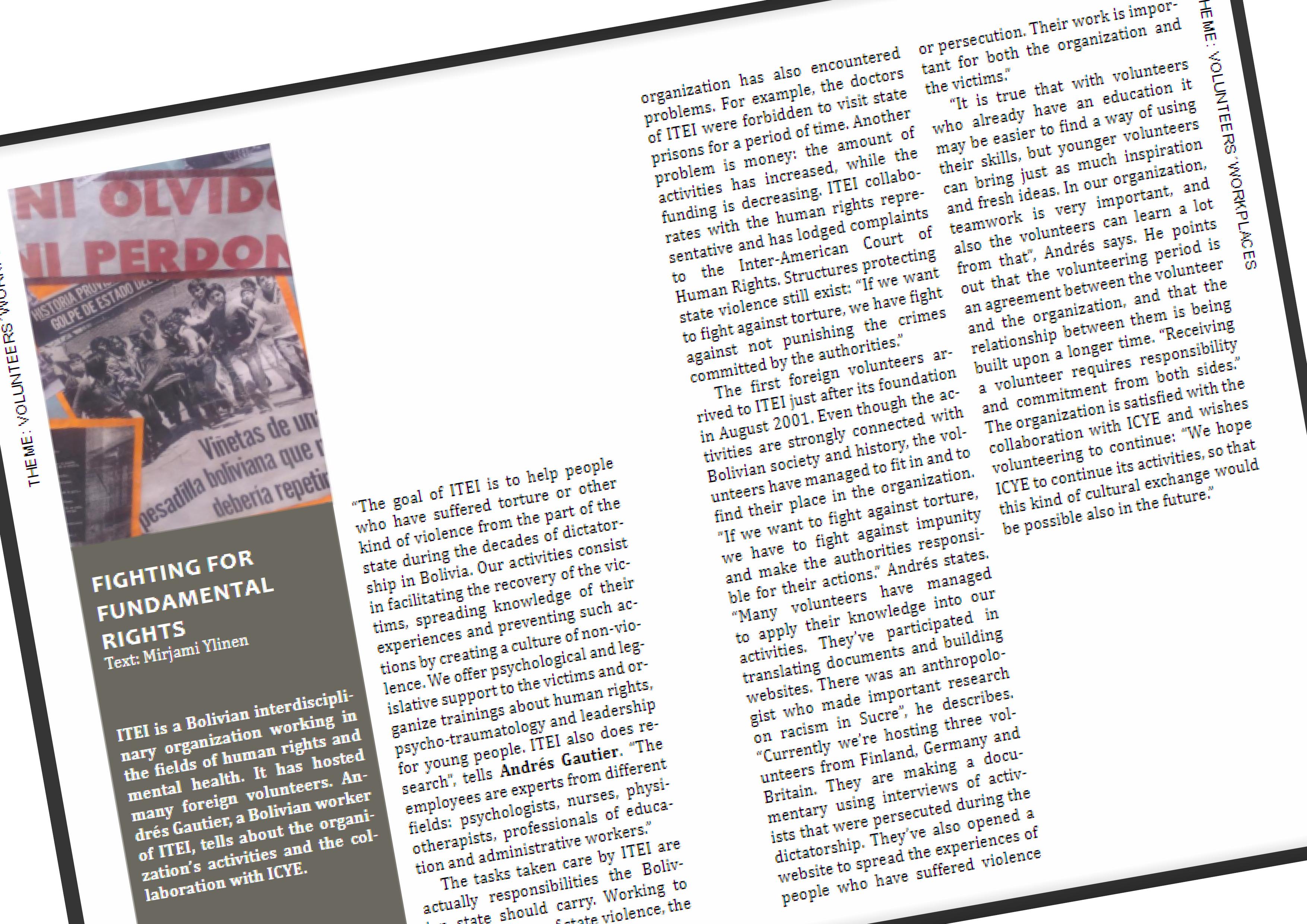
Fighting for Fundamental Rights

ITEI is a Bolivian interdisciplinary organization working in the fields of human rights and mental health. It has hosted many foreign volunteers. Andrés Gautier, a Bolivian worker of ITEI, tells about the organization’s activities and the collaboration with ICYE.

“The goal of ITEI (Instituto de Terapia e Investigación) is to help people who have suffered torture or other kind of violence from the part of the state during the decades of dictatorship in Bolivia. Our activities consist in facilitating the recovery of the victims, spreading knowledge of their experiences and preventing such actions by creating a culture of non-violence. We offer psychological and legislative support to the victims and organize trainings about human rights, psycho-traumatology and leadership for young people. ITEI also does research”, tells Andrés Gautier. “The employees are experts from different fields: psychologists, nurses, physiotherapists, professionals of education and administrative workers.”

The tasks taken care by ITEI are actually responsibilities the Bolivian state should carry. Working to help the victims of state violence, the organization has also encountered problems. For example, the doctors of ITEI were forbidden to visit state prisons for a period of time. Another problem is money: the amount of activities has increased, while the funding is decreasing. ITEI collaborates with the human rights representative and has lodged complaints to the Inter-American Court of Human Rights. Structures protecting state violence still exist: “If we want to fight against torture, we have fight against not punishing the crimes committed by the authorities.”

The first foreign volunteers arrived to ITEI just after its foundation in August 2001. Even though the activities are strongly connected with Bolivian society and history, the volunteers have managed to fit in and to find their place in the organization. ”If we want to fight against torture, we have to fight against impunity and make the authorities responsible for their actions.” Andrés states. “Many volunteers have managed to apply their knowledge into our activities. They’ve participated in translating documents and building websites. There was an anthropologist who made important research on racism in Sucre”, he describes. “Currently we’re hosting three volunteers from Finland, Germany and Britain. They are making a documentary using interviews of activists that were persecuted during the dictatorship. They’ve also opened a website to spread the experiences of people who have suffered violence or persecution. Their work is important for both the organization and the victims.”

“It is true that with volunteers who already have an education it may be easier to find a way of using their skills, but younger volunteers can bring just as much inspiration and fresh ideas. In our organization, teamwork is very important, and also the volunteers can learn a lot from that”, Andrés says.

“It is true that with volunteers who already have an education it may be easier to find a way of using their skills, but younger volunteers can bring just as much inspiration and fresh ideas. In our organization, teamwork is very important, and also the volunteers can learn a lot from that”, Andrés says. He points out that the volunteering period is an agreement between the volunteer and the organization, and that the relationship between them is being built upon a longer time. “Receiving a volunteer requires responsibility and commitment from both sides.” The organization is satisfied with the collaboration with ICYE and wishes volunteering to continue: “We hope ICYE to continue its activities, so that this kind of cultural exchange would be possible also in the future.”

Text: Mirjami Ylinen

The article has been published in Volunteers’ Voices 4/2014.

Read also

MaailmanVaihtoa – Volunteers’ Voices 1/2023: Language and Communication

 In this issue Read the pdf version of the...

Greetings from abroad: From Finland to Austria and from Taiwan to Finland

Each year Maailmanvaihto sends and receives young people for long-term...

Towards Meaningful Meetings in Volunteering

In international volunteering the participants learn through daily co-operation. At...

Volunteers’ Voices 1/2017: cultural identity

Editorial: I am a Finn – With a Piece of Peru inside Me

The theme of this magazine in front of you, is cultural identity. While I was in Peru, I discovered some new dimensions of the love I feel for my country, Finland. Every time I watched a certain documentary about Finnish men going to sauna, I cried like a baby because I was so proud of them. On the other hand I was so excited when I saw a Finnish ensemble singing on television at the airport of one Peruvian city in the mountains. The same happened, when I found a chocolate figure wearing a typical Lappish hat in a local supermarket, and didn’t forget to tell everybody about Finland’s Independence Day on the sixth of December. Things that reminded me of my background and my roots gave me both the feeling of safety but also the feeling of irritation. Once when I was eating with Peruvian people, they told me I was very quiet. I got confused – I just had nothing to say!

When I was back in Finland, no one gave me cheek kisses and I honestly felt like I lacked something. Even though it’s been two years since my return, there’s still certain things that remind me of Peru, but that other people around me wouldn’t understand.

Already during half a year, a piece of the country one is volunteering in, can find a place in the volunteer’s heart. When I was back in Finland, no one gave me cheek kisses and I honestly felt like I lacked something. Even though it’s been two years since my return, there’s still certain things that remind me of Peru, but that other people around me wouldn’t understand. The chance to get to know one culture a little bit deeper has enriched my life in many, many ways, but at the same time taught me to know my own roots better.

International activities in one’s own country can also give a chance to get to know new cultures better. Next time when you have the chance to get to know people from abroad in your own country, go ahead and take the chance! By doing that you can really open new doors to the world.

I wish you beautiful spring days!

Kaisa Rahko

The writer volunteered in a Peruvian kindergarten in 2014–15 and has just started working as the other editor-in-chief of the magazine.

In the issue

5 Kutsu kevätkokoukseen
6 Ajankohtaista
9 Against Discrimination
10 Lagos – Moderni afrikkalainen metropoli
12 koulutuskuulumisia Itävallasta
Teema: Kulttuuri-identiteetti | Theme: Cultural Identity
— 14 Juurista se kulttuuri-identiteettikin kasvaa
— 20 Muukalaislegioonassa
22 Friends of Various Ages
24 Cultural Learning and Spicy Cookery
26 Vaikuttavaa yhteistyötä
28 Welcoming Volunteers to a School in Kumasi
30 Vapaaehtoistyötä Kaukomailla
32 Tule mukaan toimintaan!
33 Lehden parissa
34 Toiminnan lähtökohtia
35 Tapahtumakalenteri

ISSN 2342-2629 (Printed)
ISSN 2342-2637 (Online version)

Read also

MaailmanVaihtoa – Volunteers’ Voices 2/2025: Environment and International Volunteering

Read the magazine in pdf. In this issue: Pääkirjoitus /...

Vounteers’ Voices 2/2023: Decolonising international volunteering

Read the issue in pdf In this issue 4 Pääkirjoitus...

MaailmanVaihtoa – Volunteers’ Voices 1/2023: Language and Communication

 In this issue Read the pdf version of the...