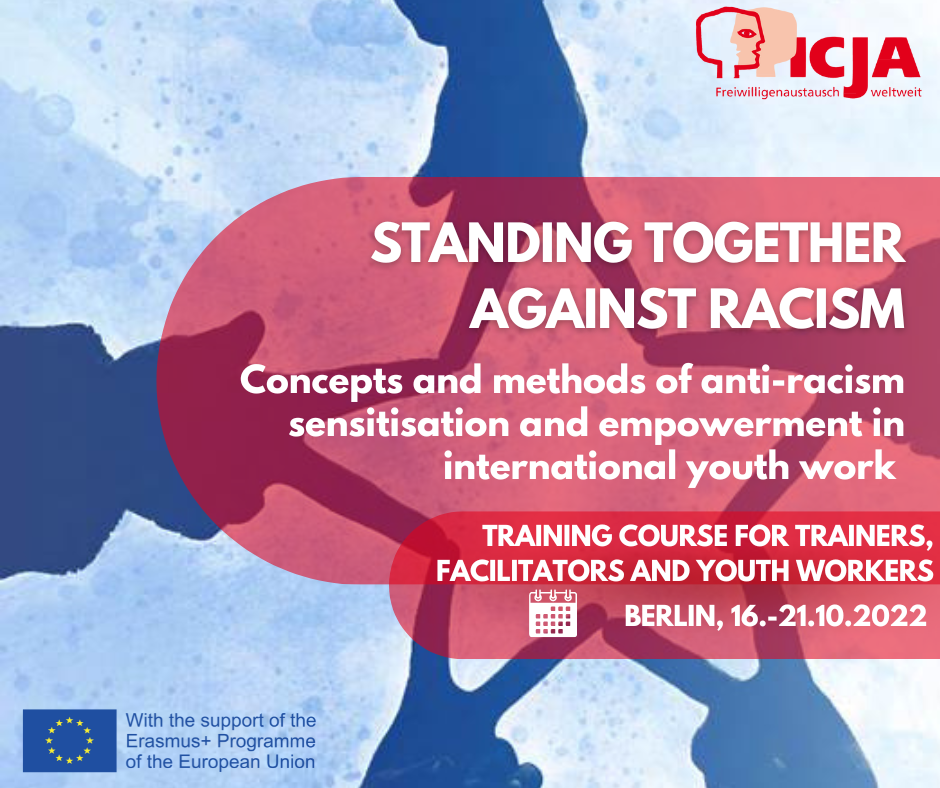
Standing Together Against Racism – Training Seminar 16.–21.10.2022

Hello participant of Maailmanvaihto’s activities! Have you acted as a trainer or team leader at Maailmanvaihto’s camps or trainings or elsewhere in the youth work field? Are you living in Finland and want to learn more about anti-racism education? Our partner organization ICJA will host a training about this topic during 16.10.–21.10.2022 in Berlin, Germany. Join in, we can send two participants!

Training on racism- and discrimination sensitive education for youth workers, educators and youth leaders

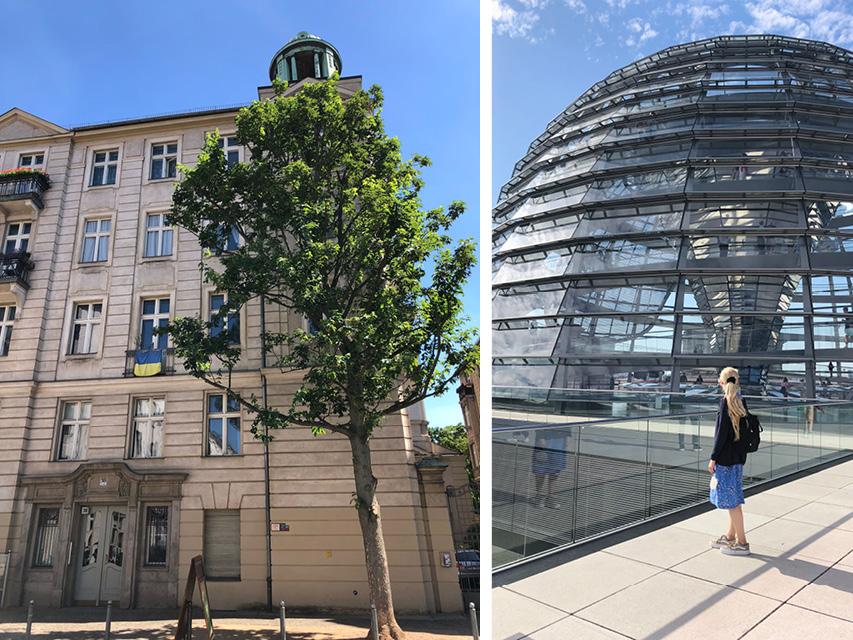
  • Location: Seminarhaus Spreeinsel in Berlin, Germany
  • Dates: 16.10.–21.10.2022
  • Age: 18+
  • Language: English
  • Hosting organization: ICJA
  • Places available for Maailmanvaihto’s participants: 2
  • Participation fee: You will need to pay a participation fee of 60 €. Maailmanvaihto will pay the participation fee back to you if after the training you will make use of the things you learnt in your activities at Maailmanvaihto – which is, of course, something we wish for!
  • Acommodation and food will be organized by the host organization.
  • Travel expenses from Finland will be reimbursed up to 275  € or up to 320 € if green travel is used, according to real costs

The aim of the training is to raise awareness for trainers and team leaders engaged in political education work on the topics of anti-racism and anti-discrimination. By applying different methods of the anti-bias and diversity approach, reflection and awareness of one’s own or attributed social positioning and the associated social advantage or disadvantage is triggered. In this way, the multipliers acquire important knowledge and master skills in order to be able to work sensitively with various groups on these topics in the future. Theoretical input is made tangible through interactive methods. The participants of the training will develop concrete strategies on the topics of discrimination and racism as well as the ways of framing them in order to implement in their educational work and/or in their organizations.

The training will consist of the following modules:

  • Nonviolent Communication – Insights into the concept of Nonviolent Communication. How does this approach help us to work together in an appreciative and peaceful way on the topic of anti-racism in political education?
  • Reflection on one’s own and externally attributed social positioning – The participants reflect on their own positioning in society and the associated social privileges and disadvantages along different forms of discrimination. For this purpose, methods of the anti-bias approach are carried out and presented, which the participants can use themselves in their educational work in the future. Please find here some examples of methods we will work with.
  • Criticism of racism, Intersectionality and Diversity – Here we ask ourselves the following questions: How does racism and other forms of discrimination work? What is behind the approaches “Intersectionality” and “Diversity”? The approaches and the methods are applicable and can be adopted by the participants in their later educational work.
  • Discrimination-sensitive educational work – In this module, the participants develop ideas and strategies together on how they can design their own educational work in a way that is sensitive to discrimination. What do we need for creating a peaceful environment? What must be considered?
  • Specific project work – Here the participants develop their own action plan, which they intend to implement in their own work and/or organization over the next few months.

Become part of the international community that works for peace and a world without discrimination!

Requirements for participation:

  • You have initial working experience as a trainer or team leader in youth or non-formal political education work
  • You have first experiences with the topics of anti-discrimination and anti-racism
  • You are already involved or you would like to get involved in anti-racist and anti-discrimination educational work in the future
  • You have already dealt with your own experiences of discrimination and feel stable enough to talk about different forms of discrimination in a diverse group.
  • You are ready to leave your safe space and work in a diverse group on these topics with people who have had very different experiences than you.
  • You are willing to deal with your own discriminatory behavior in a self-critical manner
  • You are willing to empathize with the experiences of other people and to deal with them in an appreciative and sensitive manner

The training is structured in such a way that you can also integrate modules, experiences and results in your own work.

Other information

  • Participation fee: the organizer has tried to adjust the fee to the purchasing power in the different countries
    Fee for participants from Germany West and North European countries: 60,-€
    Fee for participants from South and East European countries: 30,-€
  • Besides from Finland, the training welcomes participants from organizations in France, Germany, Italy, and Spain, 1–2 participants per organisation
  • The hosting organization will organise the accommodation and cover the costs for accommodation and food.
  • The participants will get reimbursement of the travel expenses. The reimburesement will be calculated according to the flat rate of the ERASMUS + programme. Also possible visa costs will be reimbursed.
  • The dates of 16.10.2022 and 21.10.2022 are allocated for travel days.

Accessibility information

If you would like to get accessibility information, please contact ICJA at youthexchange@icja.de.

How to apply

To apply, please download and fill in the application form (docx) and send it to us at Maailmanvaihto to maailmanvaihto@maailmanvaihto.fi on Sunday 28th August at the latest. If you wish to gain further information, please write us to the mentioned e-mail address. We will select the participants soon after the application deadline.

Read also

Practice languages in Maailmanvaihto’s Language Café

Would you like to practice speaking in Spanish or Finnish...

For young people living in Finland: circular economy, second-hand shop, children’s aid… … apply now to volunteer in Iceland!

Hey, are you living in Finland, between 18 and 30...

For young people living in Finland: Workshops for young people, social media outreach… apply now to volunteer in Italy!

Hey, are you living in Finland, between 18 and 30...

Join Maailmanvaihto at the Helsinki Pride Parade and the Pride Picnic on June 27, 2026!

Dear friends, Helsinki Pride is here again! Let’s celebrate diversity,...

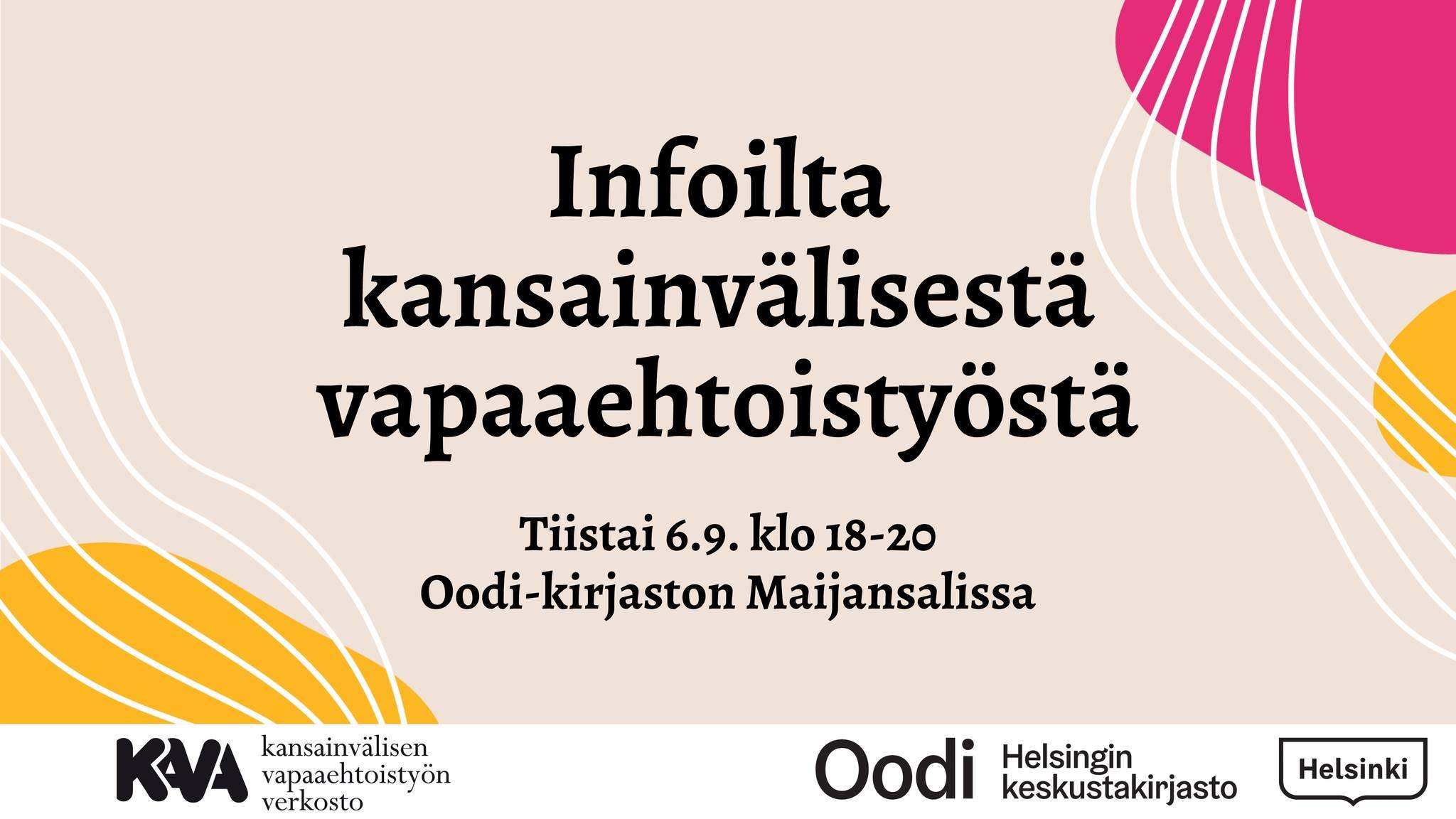
KaVa’s info on International Volunteering 6.9.2022

Interested in volunteering in Europe or further away? You are welcome to join the info events of Kansainvälisen Vapaaehtoistyön Verkosto KaVa (the Network of International Volunteering)! During the events, you will gain information on the possibilities to head abroad via the network’s members and hear about the experiences of volunteers.

The time of the event is Tuesday 6th September 2022 at 6–8 p.m. in Helsinki. The event will take place in Helsinki Central Library Oodi, in Maijansali hall. No registration required, you may join at any point during the event.
The events are open for all. The events will be held, at least mainly, in Finnish. The participants commit to building for their part an atmosphere in which all are respected.

The members of the network are Allianssi Youth Exchanges, Kansainvälinen vapaaehtoistyö ry (KVT), and Maailmanvaihto – ICYE Finland.
The Network of International Volunteering advances quality and responsible volunteering.

– The members of the network send volunteers abroad to local grass-root level projects and receive volunteers to Finland.
– The volunteering periods last from a few weeks up to a year.
– An aim and a purpose have been thought for the volunteering, and the activities of the members of the network are non-for-profit.
– The goal of volunteering is intercultural learning as well as advancing global responsibility and active citizenship.
– In Finland, one can join in gaining international experiences in the voluntary activities of the network.

Welcome!
Get to know the other organizations:
– https://www.nuorisovaihto.fi
– https://www.kvtfinland.org

Welcome to follow our accounts! #KaVaDays
– IG: @nuorisovaihto, @kvtfinland, @maailmanvaihto
– FB: @nuorisovaihto, @kansainvalinenvapaaehtoistyo, @maailmanvaihto

Read also

Practice languages in Maailmanvaihto’s Language Café

Would you like to practice speaking in Spanish or Finnish...

For young people living in Finland: circular economy, second-hand shop, children’s aid… … apply now to volunteer in Iceland!

Hey, are you living in Finland, between 18 and 30...

For young people living in Finland: Workshops for young people, social media outreach… apply now to volunteer in Italy!

Hey, are you living in Finland, between 18 and 30...

Join Maailmanvaihto at the Helsinki Pride Parade and the Pride Picnic on June 27, 2026!

Dear friends, Helsinki Pride is here again! Let’s celebrate diversity,...

3rd May online info: Become a host family or a support person for a young volunteer

Would you like to participate in cultural exchange in the place you live in? Join in the online info event of the youth exchange organization Maailmanvaihto to learn about the possibilities to become a host family for a young volunteer from abroad! You will also get information on becoming a support person or a support family for a volunteer.

🗓️ Tue 3rd May 2022 at 16.30–18.00
📍 In Zoom (we will send the link to those who sign up)

Young people from different sides of the world arrive through Maailmanvaihto in Finland for 6–12 months of volunteering. Besides bringing to their voluntary workplaces extra hands, they bring an international aspect to the activities. The volunteers work in common-good organizations, such as schools and workshops for people with disabilities.

Hosting a volunteer and being a friend and support for them are voluntary activities, which offer a great chance to be of help, gain international experience, strengthen language skills, and see one’s own environment from a new perspective. We coordinate volunteering periods in different parts of Finland. Most of the volunteers arrive in Finland in August.

The programme of the online info event:

  • Become a host family or a support person, Maailmanvaihto’s programme coordinator Mari Takalo
  • Experiences of a host family, Markus and Liisa Kivistö
  • Experiences of a support person, Riikka Lampola
  • Questions and feedback from the audience

Warmly welcome! The online info event is open to join for all who are interested in the topic. We will hold the online info in Finnish, at least for the major part.

Sign up by emailing us at tiedottaja@maailmanvaihto.fi. We will send you a link to the Zoom meeting.
The accessibility information of Zoom you can find at https://explore.zoom.us/en/accessibility. If you have questions or wishes about the accessibility of the event, please contact us: tiedottaja@maailmanvaihto.fi.

We wish to build in all Maailmanvaihto’s activities an atmosphere in which all participants can feel welcome as themselves. To support this, we will follow during the online info event Maailmanvaihto’s Guidelines for Safer Spaces.

Read also

Practice languages in Maailmanvaihto’s Language Café

Would you like to practice speaking in Spanish or Finnish...

For young people living in Finland: circular economy, second-hand shop, children’s aid… … apply now to volunteer in Iceland!

Hey, are you living in Finland, between 18 and 30...

For young people living in Finland: Workshops for young people, social media outreach… apply now to volunteer in Italy!

Hey, are you living in Finland, between 18 and 30...

Join Maailmanvaihto at the Helsinki Pride Parade and the Pride Picnic on June 27, 2026!

Dear friends, Helsinki Pride is here again! Let’s celebrate diversity,...

Training: Young Activists Communicating Peace 15.8.–22.8.2022 in Germany

Hey you, who are participating in Maailmanvaihto’s activities! Participate the training ”Young Activists Communicating Peace” which offers skills for peace work and peace education in the field of international volunteering!

”In recent years, we have observed an increasing radicalization in public communications and an increase in hate speech on social media. News and social media are dominated by escalating and polarizing language. Nationalist, anti-democratic and racist actors are threatening social cohesion worldwide with targeted fake news. This has become increasingly clear over the past 10 years and has reached a new level since Russian troops invaded Ukraine: democracy and peace are under threat worldwide.

With this training, which is part of our long-term project ”Young Activist for Peace”, we want to remind you that we as human beings are also characterized by the ability to communicate successfully, to cooperate, to show compassion and to act in solidarity. We believe that the ability to communicate successfully is a key to greater understanding and appreciation for one another and contributes to a more peaceful society.”

Learn about the contents of the training and about other information from description of the training (pdf) and on the website of ICJA. Apply as a participant if you are involved in Maailmanvaihto’s activities and are interested in peace work and conflict resolution and would like to learn about non-violent communication and transactional analysis. Maailmanvaihto can send to the training 1 or 2 participants.

As a participant, you will be provided with accommodation and meals, and you will receive a reimbursement of the travel expenses (from Finland, 275 Euros or 320 Euros if you will use low-emission transport).

You will need to pay a participation fee of 40 €, but Maailmanvaihto will later reimburse it for you if you will make use of what you learned in the training in Maailmanvaihto’s activities.

The training is meant for people aged at least 18 years and it will be held in English. The funding decision hasn’t yet been made for the training, so it’s not yet totally sure that the training will take place. We will let those who are chosen as participants as soon as the funding decision has been made.

How to join?

Apply by sending a message to Maailmanvaihto at maailmanvaihto@maailmanvaihto.fi. We will fill the positions as soon as suitable candidates are found, and we can receive applications until 30th June 2022.

Questions?

If you would like to ask about the training, we will be glad to answer! You can receive further information from Secretary General Anni Koskela: maailmanvaihto@maailmanvaihto.fi, 050 345 5660.

Read also

Practice languages in Maailmanvaihto’s Language Café

Would you like to practice speaking in Spanish or Finnish...

For young people living in Finland: circular economy, second-hand shop, children’s aid… … apply now to volunteer in Iceland!

Hey, are you living in Finland, between 18 and 30...

For young people living in Finland: Workshops for young people, social media outreach… apply now to volunteer in Italy!

Hey, are you living in Finland, between 18 and 30...

Join Maailmanvaihto at the Helsinki Pride Parade and the Pride Picnic on June 27, 2026!

Dear friends, Helsinki Pride is here again! Let’s celebrate diversity,...

4th April online meeting: Together towards more inclusive volunteering

  • Mon 4th April 2022 at 14.30–16.00 EET (13.30–15.00 CET)
  • In Zoom (we will send the link to those who sign up)

The European Solidarity Corps offers inspiring volunteering opportunities for young people, but how could we advance the accessibility for all kinds of young people – including those who need additional support? What kind of knowhow, practises and co-operation would we need to become more inclusive?

You are warmly welcome to explore these questions together at the online meeting of Maailmanvaihto – ICYE Finland. You will get a chance to share and discuss the challenges and good practices, and to brainstorm for co-operation possibilities. The event is targeted at all organizations who send or receive European Solidarity Corps volunteers or coordinate volunteering projects, but it’s open for all interested in working on inclusion.

In the meeting, you will hear about Maailmanvaihto’s European Solidarity Corps intern Roos Freije’s recent exploration of inclusive European Solidarity Corps volunteering. Roos will share the results and good practices.

In addition, European Solidarity Corps volunteer Susanna Halme will share their expertise by experience on advancing inclusion in international volunteering. Susanna participated through Maailmanvaihto – ICYE Finland in the European Solidarity Corps project called “Grenzenlos without Barriers” of the youth exchange organization Grenzenlos in Austria.
The event will be held in English.

Maailmanvaihto – ICYE Finland works as a sending and receiving support organization for volunteers of the European Solidarity Corps, besides which we coordinate European Solidarity Corps projects in Finland.

Signing up

Sign up by sending a message to the address tiedottaja@maailmanvaihto.fi. We will send you the link to the meeting.

Accessibility and building a safer space

The accessibility information of Zoom is available in the address https://zoom.us/accessibility. We can send the presentation slides of the meeting for the participants in advance If you have questions or wishes related to the accessibility, please don’t hesitate to contact us: tiedottaja@maailmanvaihto.fi.

We wish to build in all Maailmanvaihto’s activities an atmosphere in which everyone can feel welcome as themselves. To support this, we will follow in the event Maailmanvaihto’s Guidelines for Safer Spaces.

Read also

Practice languages in Maailmanvaihto’s Language Café

Would you like to practice speaking in Spanish or Finnish...

For young people living in Finland: circular economy, second-hand shop, children’s aid… … apply now to volunteer in Iceland!

Hey, are you living in Finland, between 18 and 30...

For young people living in Finland: Workshops for young people, social media outreach… apply now to volunteer in Italy!

Hey, are you living in Finland, between 18 and 30...

Join Maailmanvaihto at the Helsinki Pride Parade and the Pride Picnic on June 27, 2026!

Dear friends, Helsinki Pride is here again! Let’s celebrate diversity,...

Guideline on the procedure in cases of harassment

This guideline explains how Maailmanvaihto will respond to reports of harassment, unequal treatment, racism or other inappropriate behaviour in Maailmanvaihto’s activities. The reported case will be processed with the consent of the person who has been subjected to harassment.

1) A report of harassment can be made through the online form on the Maailmanvaihto homepage or, for example, in person to the event organiser, by emailing the harassment contact person or an office staff member, or by contacting the office staff via telephone. A verbal report of harassment will be carefully documented.

2) The data from the harassment reports will only be used to process the case and will only be kept for the time required to process it. All parties involved will be informed of the end of the process.

3) Cases of harassment are processed by Maailmanvaihto office staff and the board:

  1. Reports sent through the online form are forwarded to the Secretary General’s email. In the absence of the Secretary General, the report will be received by another member of the office staff. The recipient will inform the harassment contact person and the chairperson of the board.
  2. Reports received by other means will also be forwarded to the Secretary General of Maailmanvaihto and to the harassment contact person and the chairperson of the board.
  3. Anonymous reports or reports without contact details will not be processed but will be taken into account in developing Maailmanvaihto’s activities. If the report contains the sender’s contact details, the recipient of the report will contact the sender to ask for their preferences on how the case should be processed. The case will only be processed with the consent of the person subjected to harassment.
  4. Once consent has been given, the report will be processed as soon as possible and within a maximum of three weeks by the harassment contact person and the staff member responsible for the activity where the harassment took place. If a staff member or board member has been involved in the harassment case, they will not be involved in the processing of the harassment report.
  5. The processing of the case and the measures taken are carefully documented. Data will be processed and stored in accordance with the Privacy Policy. After the case has been processed, the data will be kept anonymised by Maailmanvaihto in order to improve the processing of harassment reports.

4) The person telling they have experienced harassment will not be left alone at Maailmanvaihto. The harassment contact person and the staff member who handles the case will hear out and support the person and inform him or her about psychological and other support services.

5) The Maailmanvaihto harassment contact person and the staff member will try to form as objective a picture as possible of what happened. They first interview separately the person who reported the harassment (and the subject of the harassment if different from the reporter) and the suspected harasser. The harassed person and the suspected harasser may then be heard together, if the parties and the gravity of the situation allow it. The person accused of harassment is guaranteed the right to be heard.

6) The case can be settled between the parties if this is satisfactory for the parties and if the gravity of the situation allows it. The mediation will be supported by the harassment contact person and the staff member who handle the case.

7) If mediation does not suit the parties, mediation is not possible because of the gravity of the situation, or mediation does not help, the Maailmanvaihto harassment contact person and the staff member may issue a warning to the harasser or restrict or prohibit the harasser’s right to stay on the premises or participate in the activities of the organization. The duration of the restriction or prohibition will be considered on a case-by-case basis.

8) The harassment contact person and the staff member can help in seeking help and moving criminal law matters forward.

9) In the case of a change of the harassment contact person or staff members, the new board harassment contact person or staff members will be informed of the on-going harassment cases, according to the wishes of the reporter. The old board may oblige the new board to implement the measures decided upon. In on-going cases, the old board may make a recommendation on how the new board should proceed with the case.

Read also

Practice languages in Maailmanvaihto’s Language Café

Would you like to practice speaking in Spanish or Finnish...

For young people living in Finland: circular economy, second-hand shop, children’s aid… … apply now to volunteer in Iceland!

Hey, are you living in Finland, between 18 and 30...

For young people living in Finland: Workshops for young people, social media outreach… apply now to volunteer in Italy!

Hey, are you living in Finland, between 18 and 30...

Join Maailmanvaihto at the Helsinki Pride Parade and the Pride Picnic on June 27, 2026!

Dear friends, Helsinki Pride is here again! Let’s celebrate diversity,...

Privacy Policy: Reports of harassment in Maailmanvaihto’s activities

Privacy policy
Basis: Personal Data 523/1999 *)
EU Data Protection Regulation
Date: 15.05.2022

1. The keeper of the register
Name: Maailmanvaihto ry
Business ID: 0281262-7
Address: Oikokatu 3, 00170 Helsinki
Other contact information:
Phone number: 050 452 5660
E-mail: maailmanvaihto@maailmanvaihto.fi

2. Contact person for matters concerning the register
Name: Secretary General Anni Koskela
Address: Address of Maailmanvaihto ry (above)
Phone number: 050 452 5660
E-mail address: maailmanvaihto@maailmanvaihto.fi

3. Name of the register
Reports of harassment in the activities of Maailmanvaihto

4. The purpose of processing personal data
Processing of harassment incidents reported in the context of Maailmanvaihto

5. The content of the register
1) The information submitted by the reporter,
– where the harassment occurred
– when the harassment occurred
– who harassed
– what happened and who was present
2) The name and email address and telephone number of the reporting party
3) Any other additional information provided by the reporting party
4) The reporting party’s request as to whether they want to be contacted
5) Information on the handling of the case by Maailmanvaihto

6. Normal sources of information
The information is obtained from the person who filed the harassment report through an electronic form or other means.

7. The processing of data within Maailmanvaihto

Access to documents is limited within Maailmanvaihto.
The information as such is handled confidentially by Maailmanvaihto office staff and the board of Maailmanvaihto. The reports of harassment will be forwarded via the electronic form available on Maailmanvaihto homepage to the email of the Secretary General. In his/her absence, the reports will be received by another member of the office staff.
The recipient will inform of the harassment report to the harassment contact person and the president of the Maailmanvaihto Board.

If the contact details of the reporter are included in the contact form, the person who receives the harassment report will contact the reporter and ask about the wishes of the person experiencing the harassment concerning the handling of the case. The matter will be taken up only with the consent of the person who has experienced the harassment. Once consent has been obtained, the report will be handled by the harassment contact person and the employee responsible for the activity where the harassment took place. If an employee or board member has been involved in the harassment situation, that person will not be involved in the handling of the harassment report.

8. Normal disclosures of data
The data will not be disclosed to parties outside Maailmanvaihto.

9. The transfer of data outside the EU or EEA
Personal data is stored in Google Cloud, which is located outside the EU/EEA, but is committed to complying with the requirements of the EU Data Protection Regulation.

10. The principles and retention periods for the protection of the register
IT processed data
The data in the register will be handled with care and appropriate data security protection. The electronic form on the Maailmanvaihto website sends data to the Secretary General’s account in the cloud. The data is anonymised immediately after the case is processed. All parties involved in the case will be informed once the handling of the case has ended. The time period for storing the anonymised data is unlimited.

11. Inspection rights
Data subjects have the right to inspect their data recorded in the register. The request should be made to the Secretary General of Maailmanvaihto in person or at the office address. Personal Data Act §24, EU Data Protection Regulation.

12. Right to request the correction of data
Everyone has the right to request the correction of inaccurate information contained in the register. The request for the correction of inaccurate information should be addressed to the Secretary General of Maailmanvaihto.

13. Other rights related to the processing of personal data

Read also

Practice languages in Maailmanvaihto’s Language Café

Would you like to practice speaking in Spanish or Finnish...

For young people living in Finland: circular economy, second-hand shop, children’s aid… … apply now to volunteer in Iceland!

Hey, are you living in Finland, between 18 and 30...

For young people living in Finland: Workshops for young people, social media outreach… apply now to volunteer in Italy!

Hey, are you living in Finland, between 18 and 30...

Join Maailmanvaihto at the Helsinki Pride Parade and the Pride Picnic on June 27, 2026!

Dear friends, Helsinki Pride is here again! Let’s celebrate diversity,...

Connecting with the world and volunteers in Čadca

In this series, we learn about volunteering opportunities within the ICYE network all over the world. This time it’s Sloavakia’s turn to be in the spotlight. Read what Miriam Petríková from ICYE Slovakia, KERIC, tells about volunteering with KERIC.

Interview & photo: Minna Räisänen

A green logo of non-profit organization Keric and a picture of the representative Miriam Petriková smiling to the camera.

Miriam Petriková from the youth organization KERIC welcomes new volunteers to their team: “If you would like to be part of KERIC community, experience life in Slovakia, and like working with children, we are the right place for you.”

Could you please introduce KERIC?

KERIC is a non-profit, non-governmental youth organization that works with children and young people aged 7–30 years, and also with adults from the Kysuce region. We offer various activities with an international dimension, which develop the personality of children and young people and vary according to the needs of individuals and groups. We are trying to connect our Kysuce region with Europe and gradually with the whole world.

Dozens of young people take the opportunity to travel abroad and have unique experiences in countries around the world. Every year, volunteers visit us in Čadca to share their culture, customs, and languages through fun activities.

We send groups of young people from 13 to 30 years of age to the world for international youth exchanges. The aim is to meet young people from other countries, spend some time together, cooperate during activities and communicate together in a foreign language. In this informal way, young people gain new experiences, knowledge, and contacts.

We have been cooperating with primary and secondary schools in Kysuce for a long time. Throughout the school year, once or twice a week, volunteers from abroad attend schools and help motivate pupils and students, especially in foreign language classes.

In addition, we organize regular educational activities for local youth, such as workshops on engaging topics, webinars with guests, creative workshops for school clubs, and language courses for different age groups. We also host summer camps for children aged from 7 to 16. All of this allows young people to get to know themselves better and develop their potential.

What is the most rewarding and challenging aspect of your work?

We enjoy everything we do. We are constantly learning and adapting to new conditions. We try to supplement what is missing in society, and help people meet their needs. We create space for young people to express themselves and realize their ideas. We also discuss topics that are not much talked about in a creative and open way. Every obstacle brings us forward and so we grow together.

When it comes to forming connections via international volunteering, what kinds of connections has Keric gained through the European Solidarity Corps?

We have worked in the field of volunteering for almost twenty years. During this period we have established a lot of good partnerships and we try to maintain them. We had a strategy to visit the majority of the projects where we send volunteers and to have a personal experience with the host organization, people there and activities. Another strategy was to invite our project partners for study visits or seminars so that they could get to know our project personally.

The third way of staying in contact with our partners was created during the pandemic. We organize live streams with our partners through which they can introduce their projects. These interviews are recorded and candidates for the European Solidarity Corps projects can then watch them during the preparation period.

What kind of tasks do you offer for European Solidarity Corps volunteers? How has the cooperation with long-term ESC volunteers contributed to your work community?

The tasks of our volunteers are very diverse. Firstly, the volunteers help to run communication courses for children. They prepare and run the lessons together with a young Slovak teacher. The aim of the courses is to motivate children to speak English, experience the culture of the volunteer, and have fun while speaking English. The volunteers do not have to know English very well. Their role is to motivate the kids to speak a foreign language.

Secondly, the volunteers cooperate with one or two schools in Cadca or nearby villages. The aim of the cooperation is to add an international dimension to the schools. The volunteers help teachers during their lessons, using non-formal education tools. It can be language lessons but also sports, art, IT, science, math, etc. The volunteers organize games and creative activities with the students or support the teacher in any way needed. In some classes, the volunteer might help students who need special support due to a disability or other reason.

The volunteers are motivated to get involved in the school life – to take part in school trips, special events, sports tournaments, etc. The volunteers also hold classes for students to let them experience the culture, country, and the language of the volunteer, through methods of non formal education. The volunteers prepare their activities alone or with the support of the KERIC staff.

Thirdly, once a week, the volunteers help in running the KERIC office. This task involves everyday office tasks, paperwork, preparing leaflets about our activities, updating the KERIC website and Facebook, cleaning and taking care of the facilities in KERIC, or other little tasks depending on the needs of the organization.

The volunteers are part of the KERIC team. Their personalities, experiences and needs influence activities that we offer to our local community. They bring new international dimensions to our organization and the life of our community. During the first weeks, the volunteers are actively involved mainly in teaching. Later on, they may want to get more involved in other activities, such as sports, or social work. The volunteers can also take part in a language course of their own choice.

How has Keric adapted to the COVID-19 situation? How do you see the future of international volunteering in your organization, post-COVID-19?

The COVID-19 period was hard, but the challenges we faced developed our activities in positive ways. The pandemic affected three groups of our volunteers. The first group was affected on the second half of their project. We did our best to support the group’s team spirit. We created many new modules of education, started to apply distance learning, and did a lot of hiking in our region. We took it as a challenge and we were enthusiastic to study new tools and transfer our typical activities into an online space. We did many live streams and funny challenges online. I consider this period both challenging and inspiring.

When we started to host a new group of volunteers in September 2020, we tried to put our learning experiences from spring 2020 into use to develop further our educational activities. We created methodologies for online meetings, and planned how to educate our volunteers on using IT technologies to fulfill our aims in education. It was important to focus on the mental health of our volunteers and team members, so we continued with outdoor team building activities.

Now, we are hosting the third group of volunteers and I have a feeling that the pandemic is a part of our work, plans and life.

Your greetings to those interested in volunteering in Slovakia?

We really like our KERIC community. The challenges connected with hosting young people from different countries and with different skills, knowledge and experience lead our community to unexpected positive discoveries. If you would like to be part of this community, experience life in Slovakia, and like working with children, we are the right place for you.

This article has been extracted from Maailmanvaihto’s magazine Volunteers’ Voices 1/2022 edition with the theme of connections via international volunteering. You can find the full magazine and previous releases here.

Read also

Practice languages in Maailmanvaihto’s Language Café

Would you like to practice speaking in Spanish or Finnish...

For young people living in Finland: circular economy, second-hand shop, children’s aid… … apply now to volunteer in Iceland!

Hey, are you living in Finland, between 18 and 30...

For young people living in Finland: Workshops for young people, social media outreach… apply now to volunteer in Italy!

Hey, are you living in Finland, between 18 and 30...

Join Maailmanvaihto at the Helsinki Pride Parade and the Pride Picnic on June 27, 2026!

Dear friends, Helsinki Pride is here again! Let’s celebrate diversity,...

Making connections beyond a shared language

Dasha, a European Solidarity Corps volunteer from Russia, shares what it’s like to build connections with people when there’s a language barrier present.

Text: Daria Aleksandrovna Panarina
Photo: Kisälli-Harjulanmäki

Three people are working to create masks of the Russian celebration called Maslenitsa.

Volunteer Dasha Panarina (left) is preparing a board with Maslenitsa characters for the masks at Kisälli. In the photo, Daria is working together with Heidi Lohtander, and Aleksander Kämärä is working in the background.

Hi! My name is Dasha Panarina. I’m 22 years old and come from the region of Tatarstan, Russia. I have been volunteering in Finland for five months now. I am working in an arts and crafts workshop at Kisälli-Harjulanmäki in Vihti where I assist people with mental disabilities with different handicrafts, for example, weaving carpets and making bags, and in their daily activities.

Learning to communicate through gestures and sounds

My mother tongues are Russian and Tatar but in the volunteering project, in order to communicate with my colleagues, I use English. The students at Kisälli speak Finnish, but they also know a few phrases in Swedish, Russian, Spanish and other languages. Since I know only a little bit of Finnish and the students — just very few phrases in Russian, I feel like I am communicating as if I was a child again, trying to express everything with gestures and sounds. This is the well-forgotten way to communicate. In the beginning, it was difficult to explain to the students that I didn’t understand them. Later on, I learned the Finnish phrase ‘Minä en ymmärrä’ (‘I don’t understand’) and picked up some other frequently used phrases in Finnish, which made it easier to communicate.

The arts and crafts that we do with the students take time. During this process, there is constant communication, because I need to monitor the process. In one way or another, we need to communicate. While doing their work, some students like to share something from their lives, for example, about their dogs and nephews. That way, a dialogue is started. Art is also a very associative thing. To explain something, students need to use familiar concepts. For example, in order to make a circle on a sheet, some students may refer to a ball to explain what they want to do.

“While doing their work, some students like to share something from their lives, for example, about their dogs and nephews. That way, a dialogue is started.”

Finding new ways of self expression

Right now, I have started creating my own personal project. My project is based on the celebration of Maslenitsa, a Slavic festival dedicated to the farewell of winter and the welcoming of spring. In Finland, winters are as long as in Russia, and I thought that it would be nice to share this cultural tradition of my country. The idea is to make papier-mache masks of Maslenitsa characters together with the students and celebrate this holiday with them. I hope that the time spent together preparing for this celebration will allow me to build closer connections with the students.

A group of people outside, two of whom are dancing in the middle.

Creating my personal project was also a new way to express myself and participate at work. Before arriving in Finland, I was an environmental student. That was not related to creativity at all. I can probably say that the whole expression of myself was constrained to writing reports and reading academic literature. This personal project at Kisälli provided me an opportunity to express myself creatively.

“Now I have found ways to communicate with the students, know some Finnish and I can roughly understand what they are talking about.”

Connecting through sharing

For me, in general, it is difficult to establish deep connections as I am an introvert. But with the students we connect by laughing together at jokes, sharing the same songs or something else we’re both familiar with. Recently, we talked about a disco sauna on wheels from Kirovsk, Russia. Sometimes, someone sings Russian songs like Pugacheva’s ‘Millions of scarlet roses’ and so on. I can’t say that we share the same things all the time but finding these few things we both have in common has allowed us to connect.

At the beginning of the project, I didn’t know Finnish at all and although I had an idea about people with mental disabilities, I didn’t know exactly what to expect from them. I can say that everything turned out better than I thought. Now I have found ways to communicate with the students, know some Finnish and I can roughly understand what they are talking about. Working with people with mental disabilities has definitely taught me to be more patient.

This article has been extracted from Maailmanvaihto’s magazine Volunteers’ Voices 1/2022 edition with the theme of connections via international volunteering. You can find the full magazine and previous releases here.

Read also

Practice languages in Maailmanvaihto’s Language Café

Would you like to practice speaking in Spanish or Finnish...

For young people living in Finland: circular economy, second-hand shop, children’s aid… … apply now to volunteer in Iceland!

Hey, are you living in Finland, between 18 and 30...

For young people living in Finland: Workshops for young people, social media outreach… apply now to volunteer in Italy!

Hey, are you living in Finland, between 18 and 30...

Join Maailmanvaihto at the Helsinki Pride Parade and the Pride Picnic on June 27, 2026!

Dear friends, Helsinki Pride is here again! Let’s celebrate diversity,...

Apply for European Solidarity Corps Volunteering at Vanhamäki!

Are you aged 18–30 years? Would you like to develop your know-how and language skills & learn about organic farming? Are you interested in international co-operation?

Apply for European Solidarity Corps volunteering at Vanhamäki! Vanhamäki is an activity center and an organic farm located in Suonenjoki in central Finland. The center produces berries and vegetables, offers activities for its visitors, and organizes activities for people who have fallen out of the job market.

Vanhamäki is looking for a young person for a volunteering period at Vanhamäki 1.4.–31.10.2022, when 2–3 other European Solidarity Corps volunteers from different sides of Europe will volunteer at Vanhamäki, too.

Apply if you are interested in organic farming and international co-operation! You will get to work and live with other young European Solidarity Corps volunteers from different countries. You will have a chance to learn new skills, practice your language skills and advance intercultural understanding through everyday co-operation.

During your volunteering period, you will get to do different kinds of tasks outdoors and indoors. From spring to autumn, the tasks will concentrate on organic farming, from planting to harvesting. In addition, you will get to assist in making organic products, in social media tasks, and in maintenance work of the park area of Vanhamäki. You can also, according to your skills, help in planning and carrying out events, in office work and in kitchen work. You can also assist in organizing activities for unemployed people.

A collage of tho photos: on the left vegetables and root vegetables on bences outside, on the right hands reaching out to a pizza on a baking tray.

What is the European Solidarity Corps?

European Solidarity Corps is an EU-funded program that supports the international volunteering of young people. In the European Solidarity Corps, young people participate in projects which strengthen solidarity and social cohesion. Welcome to join in are all those 18–30-year old young people and organizations which want to work for a more solidary society.

For whom?

The position is meant for an 18–30-year-old person who lives is in one of the program countries or partner countries of the European Solidarity Corps. You can see the countries on the program information page. NB! Due to the tight schedule, the position is meant for a person who doesn’t need a residence permit to Finland.

The position can fit you well if you recognize yourself from these:

  • I am interested in organic farming and nature.
  • I enjoy practical tasks and teamwork.
  • I am ready to work outdoors during different seasons.
  • I can communicate in English in practical situations.

It is important that the volunteers enjoy both practical and social work tasks and are ready to work outdoors in different seasons. It is good to have an interest in organic farming and nature.

You don’t need to have any prior education or work background, and if you wish, you can receive support for learning Finnish during your volunteering period.

A building in a snowy scenary.

Accommodation and other practical arrangements

You will be accommodated in your own room in a building in Vanhamäki. You will have access to a shared kitchen and bathroom. Daily meals (breakfast, lunch, and dinner) will be partly offered in the restaurant of Vanhamäki, and partly you will cook meals out of ingredients offered by Vanhamäki.

In addition to accommodation and meals, you will get pocket money 5 euros in a day (150–155 € / month) as well as insurance for the duration of your volunteering period. Vanhamäki is located about three kilometers away from the center of Suonenjoki. If you wish, you can borrow a bicycle from Vanhamäki for your journeys to the center.

Accessibility

The volunteering tasks related to organic farming are mostly physical, and the buildings of Vanhamäki are not completely accessible, for example. If you are an applicant with a physical or sensory disability, please contact us prior to applying for consultation if the volunteering environment and tasks would be suitable for you and if the support needed could be arranged.

Vanhamäki’s website and social media channels

Website: vanhamaki.fi
The volunteers of Vanhamäki in Instagram
Vanhamäki in Instagram
The volunteers of Vanhamäki in Facebook
Vanhamäki in Facebook

Get to know also the experiences of Vanhamäki’s volunteers, on Maailmanvaihto’s website.

How to apply?

Read the general information on European Solidarity Corps volunteering and visit then this page to read the applying instructions and to download the application form. Apply as soon as possible! The position will be filled as soon as a suitable candidate is found.

Further information

Would you like to ask something about the open position for European Solidarity Corps volunteering? Please, contact us – we will be happy to answer! You can reach us at hosting@maailmanvaihto, and +358 (0)44 318 0888.


A building on a snowy day, on top of the front door it says in Finnish "a farm store".

Read also

Practice languages in Maailmanvaihto’s Language Café

Would you like to practice speaking in Spanish or Finnish...

For young people living in Finland: circular economy, second-hand shop, children’s aid… … apply now to volunteer in Iceland!

Hey, are you living in Finland, between 18 and 30...

For young people living in Finland: Workshops for young people, social media outreach… apply now to volunteer in Italy!

Hey, are you living in Finland, between 18 and 30...

Join Maailmanvaihto at the Helsinki Pride Parade and the Pride Picnic on June 27, 2026!

Dear friends, Helsinki Pride is here again! Let’s celebrate diversity,...