Maailmanvaihto’s office will remain closed on Thursday 14 May 2026.

Maailmanvaihto’s office will remain closed on Thursday 14 May 2026.
Would you like to practice speaking in Spanish or Finnish...
Do you read the magazine MaailmanVaihtoa – Volunteers' Voices? Answer...
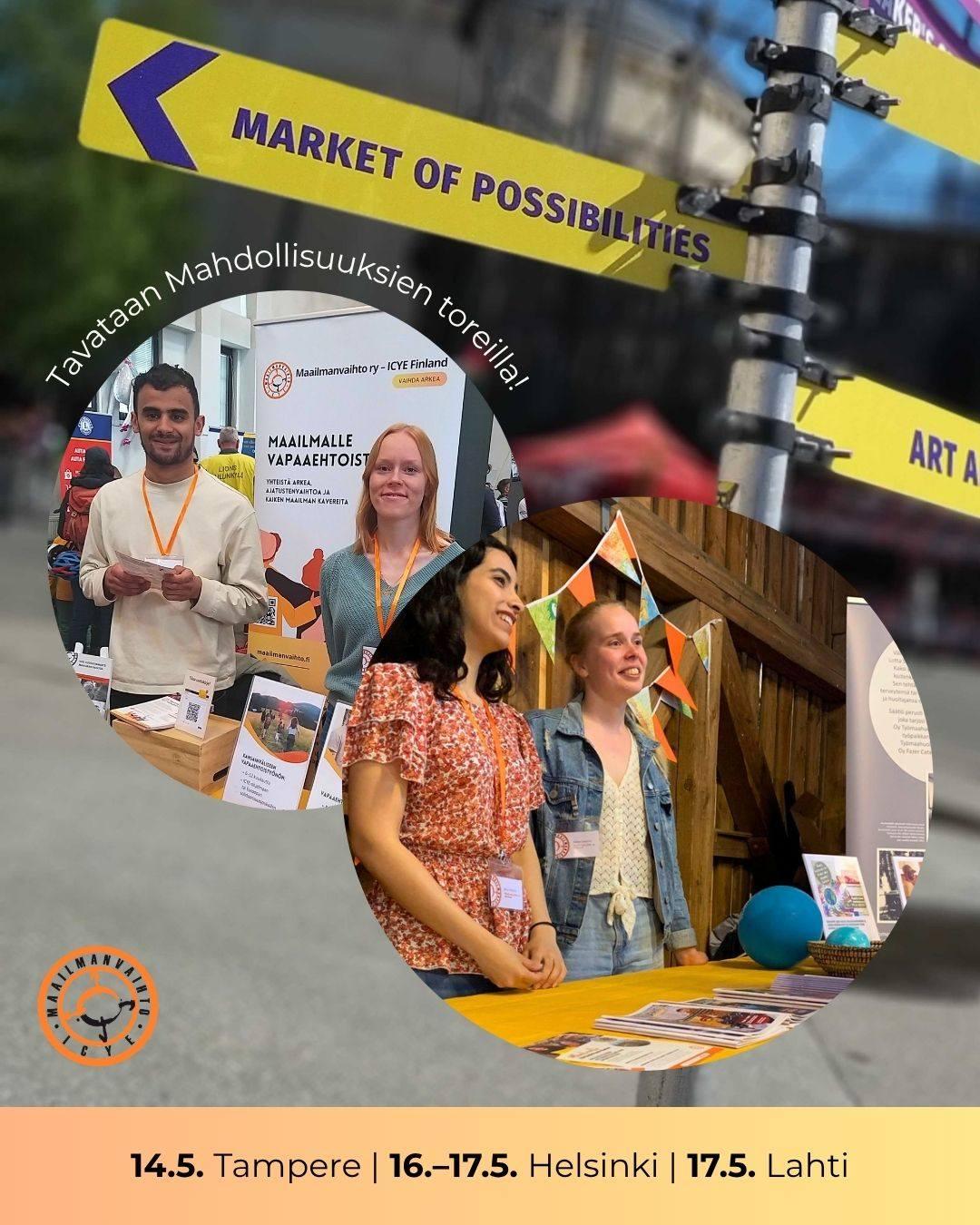
See you at the Market of Possiblities events! 🧡 We warmly invite you to come say hello to Maailmanvaihto and learn about current opportunities in our international volunteer programs and other activities!
May 14: Tampere: Market of Possiblities
May 16–17: Helsinki: Market of Possiblities at the World Village Festival
May 17: Lahti: Market of Possiblities
Would you like to practice speaking in Spanish or Finnish...
Do you read the magazine MaailmanVaihtoa – Volunteers' Voices? Answer...

Ahoj! I spent five months volunteering with the European Solidarity Corps. My project took place in Kroměříž, Czechia from September 2025 to February 2026. Starting right from the first contact with Klubíčko the whole experience has been full of joy, warmth and creativity. This volunteering project truly introduced me to a second home!
So, my volunteering project was hosted by Klubíčko Kroměříž which is a non-governmental organization. They aim to help the wellbeing of the families in the community. Klubíčk, for example, hosts an open playroom where parents can come with their children to play or perhaps enjoy a cup of coffee for a small fee. Simultaneously, it is possible for them to meet other parents or the staff of Klubíčko who are there to help with different kinds of problems that the families come across in their everyday lives. In addition, Klubíčko hosts musical play and workshops about, for example, wellbeing during pregnancy or first aid skills needed with children. Recently, they also launched an event where elders from a local nursing home were invited around to meet children!
In addition to all this, Klubíčko also maintains children’s groups for children aged 2 to 6. It is somewhat similar to how kindergartens work. Moreover, in the afternoons Klubíčko offers different kinds of activities for children: there are English language clubs, where the children learn English through games, songs, and arts and crafts, there is Folklor dancing, and there are Montessori activities. They have not forgotten the older children either. Klubíčko organizes theme events and also youth exchanges. So, it is not an easy job to summarize what Klubíčko is but all this (and even more) I got to experience while volunteering with them!

As a volunteer my days consisted of mornings in the children’s groups and afternoons in different activities. In addition, I got to fill my calendar with school visits or other events I wished to organize. Given the opportunity to choose what kinds of tasks I wanted to do not only taught me a lot but also made the whole volunteering experience very fun. Most of the time I helped with the youngest children, aged 2 to 3, so as a counterweight to that I also enjoyed going to schools to talk about both the European Solidarity Corps and Finland to the students. I even held a presentation about early childhood education in Finland and in France together with my French roommate! I was welcomed very warmly in every single place I visited. I hope that my presentations were interesting to the students and that maybe I inspired someone to consider volunteering in the future.
I shared my volunteering project with another volunteer which truly was a great thing. I didn’t learn just about Czech culture while working with the locals but I also learnt about French customs while living with a French person. It was amazing to notice how enthusiastic people were to learn about Finland and it made me see my own experiences and culture from a different point of view. However, I wasn’t just a representative of Finland but people were also interested in getting to know me personally. Of course, it was a bit of a hurdle that I spoke no Czech before moving there. Still, the same routines repeat when working with children and so my vocabulary expanded quite rapidly. I started the autumn with walking around the garden with the children and learning different colours by pointing at different coloured flowers. A great question to pick up in the beginning was “co to je?” or “what is this?”.

The biggest surprise for me was how there were no big surprises. It felt easy and natural to be in Kroměříž. I didn’t expect to experience any huge culture shocks but of course moving to another country and working with new people made me nervous beforehand. However, I got all the support I needed from Klubíčko and the people close to Klubíčko. As a volunteer I was able to meet people from different walks of life, as long as I was open to those meetings. I met wonderful and inspiring people not just in Kroměříž but from around Europe. If I was to give tips to people considering volunteering, I would say to just go for it and say yes to anything that sounds even remotely fun! When you give from yourself to volunteering you also get a lot back!
Děkuji moc,
Maria
The photo on the top: Velké náměstí, or the big square, in the city center. In the background, you can see the castle and the tower. The castle and the surrounding garden are listed as a UNESCO World Heritage Site. In the winter, we got to enjoy some sub zero temperatures and snow!
Would you like to practice speaking in Spanish or Finnish...
Do you read the magazine MaailmanVaihtoa – Volunteers' Voices? Answer...
Applicable legislation: EU General Data Protection Regulation (GDPR, EU 2016/679) and Finnish data protection legislation
Date: 22nd April, 2026
Name: Maailmanvaihto / Business ID: 0281262-7
Address: Oikokatu 3, 00170 Helsinki, Finland
Telephone: +358 50 346 0965
E-mail: maailmanvaihto@maailmanvaihto.fi
Name: Communications Officer Minna Räisänen
Address: The address of Maailmanvaihto (see above)
Other contact information: Telephone: +358 50 346 0965
E-mail: tiedottaja@maailmanvaihto.fi
Photos and Videos Register
Photos and videos are processed for the purpose of communicating about the activities of Maailmanvaihto on platforms such as:
Photos and videos are only used in accordance with the consent given by the registered person.
The register may contain the following personal data:
Only the data necessary for the stated purpose is collected.
Personal data is obtained directly from the registered persons themselves from the registered persons themselves or, where applicable, from their legal guardians or legal representatives. Consent forms are completed voluntarily.
In cases where a registered person has a legal guardian or legal representative, consent is obtained from that person in accordance with applicable law.
Personal data is handled with care and confidentiality.
Access to the register is restricted to Maailmanvaihto staff and board members who need the data to perform their work duties. All persons handling the data are bound by confidentiality obligations.
Personal data is not regularly disclosed to third parties.
With the consent of the registered person, photos and videos may also be shared with Maailmanvaihto’s partner organisations, such as umbrella organisations, for communication purposes.
With the consent of the registered person, photos and videos may be shared with representatives of the mass media for use in their publications (such as newspapers, magazines, online media, or broadcasts).
Maailmanvaihto uses Google cloud services for storing photos, videos, and consent forms. As a result, personal data may be transferred outside the EU/EEA. Such transfers are carried out in accordance with applicable data protection legislation.
Personal data is stored electronically.
Photos, videos, and consent forms are stored for as long as they are needed for the stated purpose or until consent is withdrawn.
Photos and videos are processed only for persons who have given their consent. If consent is not given, photos and videos featuring the person are not used.
If consent is withdrawn, Maailmanvaihto will remove the photos and videos as far as reasonably possible, for example from its own communication channels.
Under the GDPR, registered persons have the right to:
Requests related to these rights should be sent to the Communications Officer.
If personal data is inaccurate, outdated, or unnecessary, the registered person has the right to request correction or deletion.
Maailmanvaihto will correct or delete personal data on its own initiative or upon request, in accordance with applicable legislation.
The registered person is responsible for ensuring that the information they provide is correct and for informing Maailmanvaihto of any changes.
This privacy policy may be updated if legislation changes or if Maailmanvaihto’s data processing practices change.
The latest version will always be available upon request or on Maailmanvaihto’s website.
Would you like to practice speaking in Spanish or Finnish...
Do you read the magazine MaailmanVaihtoa – Volunteers' Voices? Answer...

If you are living in Finland and interested in sustainability and climate justice, apply for the training “Rooted & Rising”!
In this Erasmus+ training, you’ll have the opportunity to explore climate justice with an international group, share your feelings, and channel them into action. Together, we’ll learn about vulnerability in a changing climate and climate justice movements, and explore different forms of activism.
The training is organized by Maailmanvaihto’s partner organisation ICJA. You can learn more about the training and the participant profile on their website (icja.de).
We are looking for a participant from Finland who is at least 18 years old and wants to share the lessons learned from the training with Maailmanvaihto – someone who is already involved in our activities or is otherwise interested in our organization’s work.
The training is EU-funded. The participant is required to pay a €50 participation fee. The participant will be provided with accommodation and meals and will receive a reimbursement of travel costs; see the following documents for more details:
Apply as soon as possible with a free-form letter of motivation explaining why you want to participate in the training. Send your application to Maailmanvaihto at maailmanvaihto@maailmanvaihto.fi. You can also contact the same address for further information (e.g., regarding the accessibility of the training). The position will be filled as soon as a suitable candidate is found.
Are you interested in getting to know library activities abroad?...

The magazine’s second issue of the year explores the concept of home. How are volunteers accommodated? What kinds of new connections and bonds are formed when living under the same roof? How does spending time volunteering abroad shape our ideas about home?
We’re holding a brainstorming session for this issue on Wednesday, April 15, from 5:30–7:00 PM at the Maailmanvaihto office (Oikokatu 3, Helsinki) and on Zoom (we’ll send the link to those who sign up). Join us to brainstorm topics for articles! Sign up by emailing us at maailmanvaihtoalehti@maailmanvaihto.fi.
At the meeting, you can also sign up for other magazine tasks: writing an article, taking photographs, creating illustrations, or proofreading stories.
You can browse past issues of the magazine the magazine archive and find information about accessibility at our office on the contact information page.
In the braingtorming meeting, we will follow the Safer Space Guidelines of Maailmanvaihto.
Are you 18–30 and looking for a meaningful international experience...

Would you like to explore the beautiful forests and waters of Nuuksio and get to know Maailmanvaihto people? Join Maailmanvaihto for a spring hike!
📅 Sat 25/04/2026
⏰ approx. 10–16 o’clock
This is a great opportunity to meet new people and enjoy nature in Finland together. Everyone is welcome to participate, and the event is free of charge.
We’ll walk together a moderately difficult route that is suitable for people comfortable walking 5–10 km. We can have in the group maximum of 20 participants.
We’ll communicate in our group in English and we’ll follow Maailmanvaihto’s Guidelines for Safer Spaces.
Sign up! We’ll send to the registered participants all the detailed information, such as the arrival instructions, the route, tips for clothing, and instructions on safety.
Sign up here: https://forms.gle/p9TX8odZxuFNXsz3A
Got questions? Write us at intern@maailmanvaihto.fi.
We’re looking forward to meeting you! 😊
Would you like to practice speaking in Spanish or Finnish...
Do you read the magazine MaailmanVaihtoa – Volunteers' Voices? Answer...
Maailmanvaihto’s office will be closed for holidays from April 3 to 6, 2026.
Are you 18–30 and looking for a meaningful international experience...

In this piece, Anil Biçer, a European Solidarity Corps volunteer working in Maailmanvaihto’s office team, reflects on how peacebuilding is present in all the small moments of everyday life.
I still remember the first time I shared a sauna in Finland, with other international volunteers who grew up thousands of kilometers away from me. We didn’t share the same language, habits, or ideas. But we shared our moment, awkward smiles, and a lot of hand gestures. At some point, I realized something simple but powerful: peace doesn’t always start with big decisions or official agreements. Sometimes, it starts with listening, with patience, and with choosing curiosity over judgment.
Volunteering is a slow, everyday process of peace-building, where stereotypes fade, trust grows, and the invisible lines between “us” and “them” quietly disappear. Peace doesn’t always come with big words. Sometimes, it arrives quietly, over tea, shared laughter, awkward hand gestures, and in a Finnish sauna 🙂
When we hear the word “peace”, we often think about the absence of war. But in everyday life, peace is much more than that. It’s not just about what doesn’t happen. Peace is a verb, not a noun. It is the active presence of understanding, not just the absence of conflict. It’s about how we treat each other, how we listen, and how willing we are to question what we think we know. At the local level, peace is built in small, almost invisible moments. It happens when someone chooses to ask instead of assuming. When people from different backgrounds share a space without fear. When stereotypes slowly lose their power because real human stories replace them. Peace-building is the process of unlearning the “us versus them” mindset. Volunteering plays a huge role in this. It creates spaces where people don’t meet as labels, but as individuals. And once you’ve shared a meal, a task, or a laugh with someone, it becomes much harder to see them as “other.”
If peace had a main ingredient, it would probably be “dialogue”. Not the kind you see in conferences or official panels, but the everyday kind: conversations while cooking together, walking to the bus stop, or trying to explain a joke that doesn’t translate well. One of the funniest things about intercultural volunteering is that communication doesn’t always depend on words. Sometimes, it’s about facial expressions, hand gestures, drawings on papers, or just laughing at the confusion. And somehow, those moments often feel more honest than perfectly structured conversations. You learn that understanding doesn’t always need grammar, it needs attention. These small interactions slowly build more than just teamwork; they build understanding. You stop being “the Turkish volunteer”. You start being a person with different skills, habits, and stories to share. You become “The Excel Master” as in my case. Intercultural learning teaches us that differences are not problems to solve, they are experiences to explore. When we stop trying to compare whose way is “better” and start asking “why,” something shifts. Curiosity replaces fear. Dialogue replaces judgment. And that’s how peace quietly grows, one awkward but sincere conversation at a time.
“Peace-building is the process of unlearning the ‘us versus them’ mindset.”
Volunteering is often described as “helping,” but that word can be misleading. Real volunteering is not about being a hero or saving anyone. It’s about standing next to people, not above them. It’s about recognizing that some voices are heard louder than others and choosing to listen more carefully to those that are often ignored. Working with disadvantaged groups, such as people with disabilities, migrants, or refugees, teaches you something very important: inequality is not random. It is built into systems, habits, and assumptions that we rarely question. Volunteering opens your eyes to these invisible walls. You start noticing who gets access easily, who has to fight for basic rights, and who is constantly asked to “prove” their worth. From a global perspective, peace cannot exist without justice. If some lives are valued more than others, that’s not peace. That’s imbalance. Volunteering, when done respectfully, supports global justice by creating spaces of dignity, not dependency. It’s not about “giving,” but about sharing space, power, and voice. Volunteering doesn’t change the world. It changes how you see it. And once you see the world this way, it becomes impossible to unsee it.

One of the most unexpected parts of volunteering is how much it changes you. Most people start with the idea that they will contribute, support, or teach something. But somewhere along the way, the roles quietly shift. You start learning more than you ever planned to. You learn patience when things don’t go as expected. You learn empathy when someone’s story doesn’t fit into your assumptions. You learn to be okay with not having all the answers. And slowly, without noticing, you become more confident. Not because you’re “better,” but because you understand more. This is where the idea of global citizenship becomes real. Not as a fancy title, but as a mindset. You stop seeing global issues as something distant or abstract. Personally, I started seeing the world differently. Global issues like climate, inequality, migration, and access to education suddenly had faces, names, and voices for me. Volunteering teaches you that the world is not divided into “my problems” and “their problems.” It’s shared. And once you feel that, you don’t just want to observe anymore. You want to participate. You want to take responsibility. Not perfectly, but honestly. That’s how peace starts inside a person. I’ve learned that peace doesn’t just happen around me, it begins with me.
Finally, peace doesn’t arrive all at once. It is stitched together from small, everyday actions: listening instead of judging, showing up instead of turning away, choosing curiosity over comfort. Every volunteer adds a new piece to this growing patchwork; imperfect, colorful, and full of stories. You don’t need to change the whole world to be part of peace-building. You just need to start somewhere. With one conversation. One shared moment. One brave step outside your bubble. Maybe it’s volunteering. If you’ve ever wondered what volunteering really feels like, take a step. And who knows? That small step might end up changing more than you ever expected. It might not change the world, but you’ll see it differently, just like I do.
Text and photos: Anil Bicer
The story has been published in the magazine MaailmanVaihtoa – Volunteers’ Voices 1/2026: peace through international volunteering.
Would you like to practice speaking in Spanish or Finnish...
Do you read the magazine MaailmanVaihtoa – Volunteers' Voices? Answer...

After his volunteering period in Finland Sergio has attended several Maailmanvaihto camps as a kitchen team member, preparing delicious food for all the camp participants.
Hello! Who are you? How did you get involved with Maailmanvaihto?
Hello! My name is Sergio Pérez and I come from Spain. I got involved with Maailmanvaihto during my volunteering program through the European Solidarity Corps. I moved to Finland in December 2022 to spend a year as a volunteer in the Tapola Camphill community.
How have you been involved with Maailmanvaihto’s activities after your volunteering period?
After my volunteering period I joined the kitchen team for various camps and participated in get-together activities. I really enjoy meeting new volunteers and exchanging experiences with them. As a foreigner in Finland, it is a great opportunity to get to know more people that are also new in the country and build support together.
How did you end up in the camp kitchen team?
I always had great experiences in the camps and it was a lot of fun, so joining the kitchen team allowed me to keep enjoying them. I like cooking so it was an easy choice to help in the kitchen and have fun with the kitchen team while still participating in the camps and getting to know new people.
Three p
How has the experience in the camps been? What has been the best part and what did you learn?
The experience in the camps has been amazing! The best part has definitely been meeting so many people and having fun together over meals. I’ve learned how important it is to work as a team and to be flexible. Every camp has taught me something new about working together and connecting with others from different cultures.
What greetings would you give to someone considering joining the activities of Maailmanvaihto?
I’d say go for it! If you’re thinking about joining Maailmanvaihto activities, just dive in! It’s a great chance to help out, learn some cool things, and meet awesome people from all over the world.
Interview: Tuuli-Maria Mäki
Photos: Maailmanvaihto’s album
The interview has been published in the magazine MaailmanVaihtoa – Volunteers’ Voices 1/2026: peace through international volunteering.
Would you like to practice speaking in Spanish or Finnish...
Do you read the magazine MaailmanVaihtoa – Volunteers' Voices? Answer...